Mistakes when welding HDPE pipes
2023-07-06
Read more
Ziyolilar street, 4 a Tashkent, Uzbekistan
|
Working hours: Mon-Sun 9:00 - 18:00

SDR and PN table for PE80 and PE100, choosing a pipe for water and gas
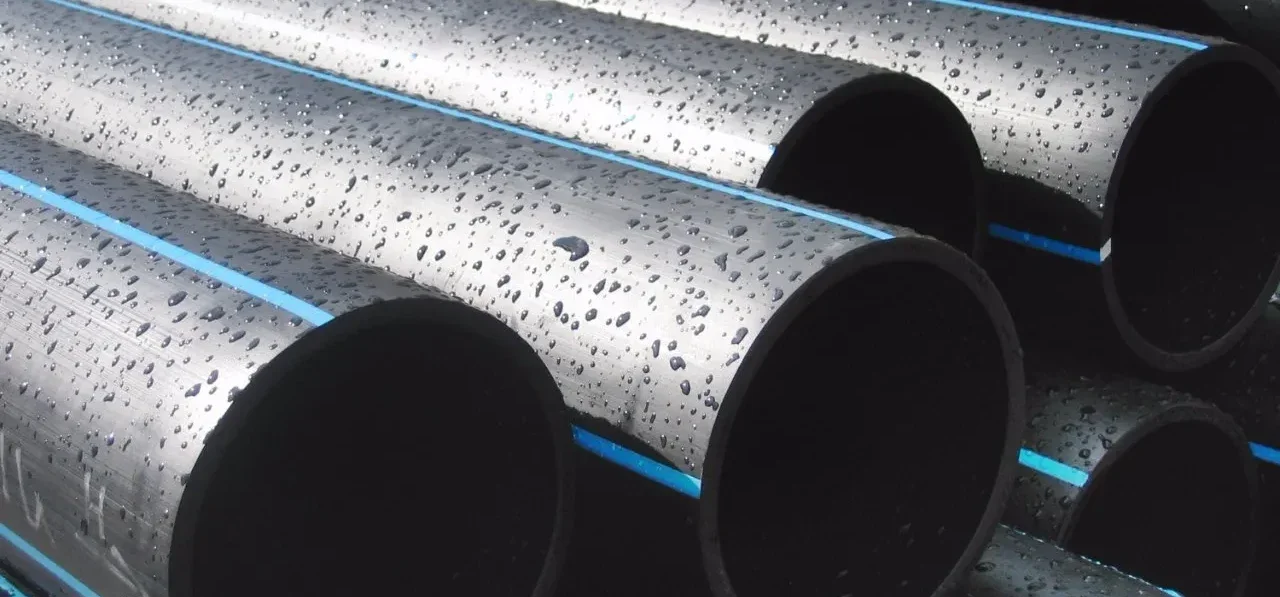
SDR and PN are the two figures in the marking of a polyethylene pipe that tell you which network pressure it suits. SDR shows how many times the outside diameter exceeds the wall thickness, PN is the working pressure of water at 20 °C. The lower the SDR, the thicker the wall and the higher the permissible pressure: a PE100 SDR 17 pipe is rated 10 bar, SDR 11 is rated 16 bar and SDR 7.4 is rated 25 bar.
SDR (Standard Dimension Ratio) is the outside diameter of a pipe divided by its nominal wall thickness. A 110 mm pipe with a 10 mm wall has SDR 110 / 10 = 11. The same pipe with a 6.6 mm wall is SDR 17, with a 15.1 mm wall it is SDR 7.4.
Pipes of different diameters with the same SDR carry the same pressure. A 32 mm SDR 11 pipe with a 3 mm wall and a 630 mm SDR 11 pipe with a 57.2 mm wall are both rated 16 bar. That is why a design or an order states the diameter and the SDR, and the wall thickness comes from the GOST 18599-2001 table.
PN is the nominal pressure in bar (1 bar is roughly 1 atm) at which the pipe serves 50 years with water at 20 °C. It depends on the SDR and on the polyethylene grade. PE100 has a minimum required strength (MRS) of 10 MPa against 8 MPa for PE80, so at the same SDR a PE100 pipe holds a quarter more pressure.
For water the pressure is calculated as PN = 20 × MRS / (C × (SDR - 1)), where C is the design coefficient, 1.25 for water supply. For PE100 SDR 17 this gives 20 × 10 / (1.25 × 16) = 10 bar. The table lists the values of GOST 18599-2001 and the wall thickness of a 110 mm pipe from our catalogue.
| SDR | PN, PE80, bar | PN, PE100, bar | Wall of a 110 mm pipe, mm |
|---|---|---|---|
| 41 | 3.2 | 4 | 2.7 |
| 33 | 4 | 5 | 3.4 |
| 26 | 5 | 6.3 | 4.2 |
| 21 | 6.3 | 8 | 5.3 |
| 17 | 8 | 10 | 6.6 |
| 13.6 | 10 | 12.5 | 8.1 |
| 11 | 12.5 | 16 | 10 |
| 9 | 16 | 20 | 12.3 |
| 7.4 | 20 | 25 | 15.1 |
Besides these nine versions the plant makes SDR 17.6 pipes: in PE100 they are rated 9.5 bar.
Start from the highest pressure in the network. Add a margin for water hammer to the pump or mains pressure: when a valve closes sharply, the pressure in the pipe briefly rises above the working level. As a rule, the pipe is chosen so that its PN is at least one and a half times the working pressure.
A private house with 3-4 bar at the inlet is usually supplied with a PE100 SDR 17 pipe. Street and district networks with pumping stations use SDR 11. Pressure mains after high-pressure pumps use SDR 9 and 7.4. Thin-wall SDR 26-41 pipes suit gravity and low-pressure lines such as irrigation.
Temperature also lowers the permissible pressure. PN is given for water at 20 °C; under EN 12201 it is multiplied by 0.87 at 30 °C and by 0.74 at 40 °C, so a PN 10 pipe holds about 7.4 bar at 40 °C. GOST 18599-2001 covers water up to 40 °C, and HDPE pipes are not used for hot water supply.
A thick wall reduces the bore. A 110 mm SDR 17 pipe has a 96.8 mm bore, an SDR 11 pipe has 90 mm. The cross-section is 14% smaller, and at the same water velocity the flow capacity drops by about as much. An SDR 11 pipe is also heavier and costs more per metre. With 4 bar in the network that is money spent for nothing.
Gas pipes are made to GOST R 58121.2-2018 with a design coefficient of at least 2, so the same pipe carries gas at a lower pressure than water. According to the plant tables, a PE100 SDR 11 gas pipe is rated 10 bar and SDR 9 is rated 12 bar. The pressure allowed in a particular gas line is set by the design under gas supply regulations. The HDPE pipes for gas section lists diameters from 50 to 630 mm in SDR 11 and SDR 9.
Gas pipes carry yellow stripes, water pipes carry blue ones.
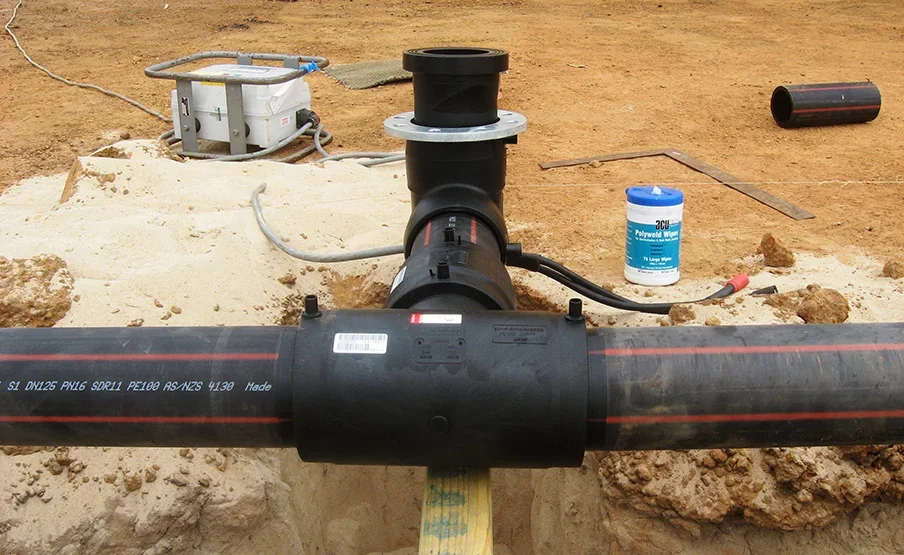
A pipe is marked with the manufacturer, polyethylene grade, SDR, the size "outside diameter × wall", purpose and standard, for example "PE100 SDR 17 110×6.6 drinking GOST 18599-2001". It tells you the pipe is PE100, rated 10 bar and suitable for drinking water. If the marking has no SDR or the wall does not match the GOST table, better not to buy that pipe.
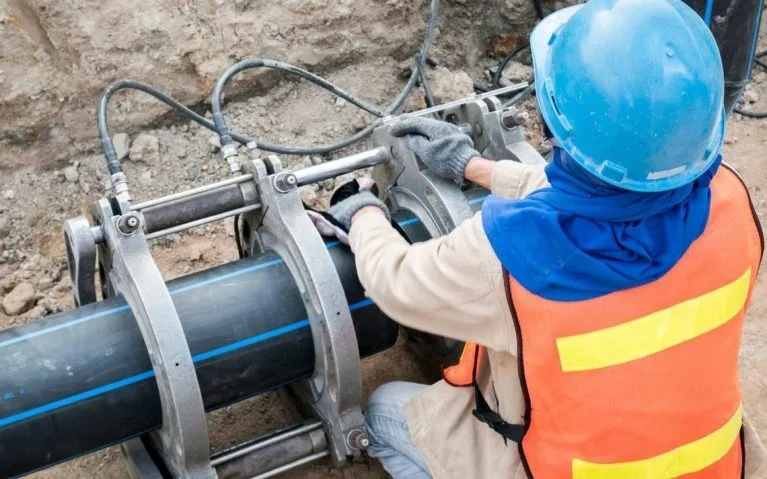
The wall thickness also sets the welding: heating and cooling times in butt fusion depend on the wall, not on the diameter. The settings are collected in the article "HDPE pipe butt fusion welding table".
All diameters and versions with wall thickness are listed in the HDPE pipes for water section. The plant's managers will help you pick the SDR for your project: give the diameter, network pressure and route length in a request on the Contacts page.
The outside diameter is 11 times the wall thickness. A PE100 SDR 11 pipe is rated 16 bar for water at 20 °C; a 110 mm pipe has a 10 mm wall.
With up to 6 bar at the inlet, a PE100 SDR 17 pipe rated 10 bar is enough. SDR 11 is used when the pressure is above 6 bar or the pipe runs from a high-head pump.
The working water pressure: 10 and 16 bar at 20 °C. In PE100 these are SDR 17 and SDR 11, in PE80 they are SDR 13.6 and SDR 9.
Irrigation at 1-3 bar works with thin-wall PE100 SDR 26-33 pipes rated 5-6.3 bar. The main line from the pump uses SDR 17.
Yes. PN is given for 20 °C: at 30 °C the permissible pressure is reduced by 13%, at 40 °C by 26%. Pipes made to GOST 18599-2001 are not used for water above 40 °C.
Measure the outside diameter and the wall thickness with a caliper and divide the first by the second. A 63 mm pipe with a 5.8 mm wall is SDR 11, since 63 / 5.8 = 10.9.

The plant has a capacity of 15,000 tons of polyethylene pipes per year. Our specialists carry out design and survey, design work on installation, installation and laying of pipelines for hot and cold water supply, heating, sewage, heating mains and drainage systems.
Address
Ziyolilar street, 4 a Tashkent, Uzbekistan