
Mistakes when welding HDPE pipes
2023-07-06
Read more
Ziyolilar street, 4 a Tashkent, Uzbekistan
|
Working hours: Mon-Sun 9:00 - 18:00

Butt fusion parameters for PE80 and PE100 by wall thickness: bead height, heat soak time, changeover, cooling and converting pressure to the gauge.
2023-07-06
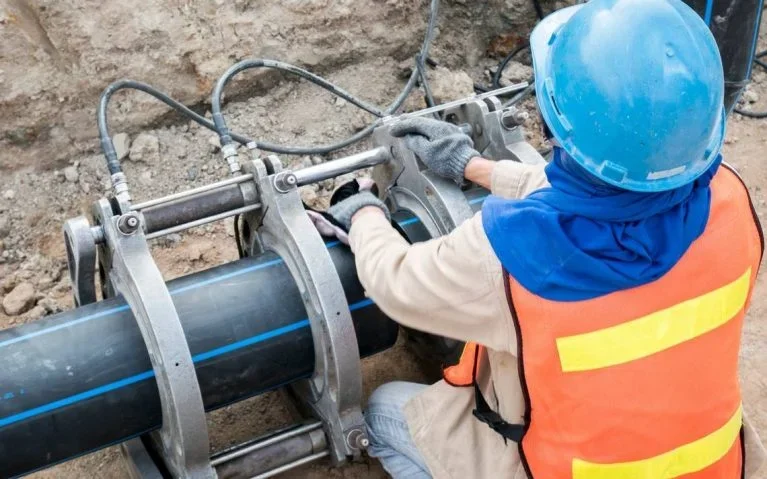
The butt fusion mode for an HDPE pipe is determined by its wall thickness. For PE100 the heater plate is kept at 200-220 °C. The ends are melted under a pressure of 0.15 MPa until a bead of 0.5 to 4 mm forms, then heated at almost zero pressure for about 10 seconds per millimetre of wall. After that the heater is removed quickly, the ends are brought together, and the weld cools under the same 0.15 MPa for 6 to 80 minutes. Exact figures for each thickness are given in the table.
Butt fusion with a heated tool produces a permanent joint between two polyethylene pipes or between a pipe and a moulded fitting. The ends are heated to a viscous state, pressed together under a calculated pressure and left to cool at rest. The polyethylene of the two parts intermixes, and the weld comes close to the strength of the pipe itself. Water and gas pipes from 40-50 mm in diameter and up are joined this way.
The process goes in steps, and each step has its own time and pressure.
The values follow the generally accepted technology for welding PE80 and PE100 pipes (DVS 2207-1, GOST R 55276-2012) at an air temperature of about +20 °C. The manual of a specific machine may give slightly different figures, and in that case the manual takes priority.
| Wall thickness, mm | Bead height at bead-up, mm | Heat soak time, s | Changeover, max, s | Cooling under pressure, min |
|---|---|---|---|---|
| up to 4.5 | 0.5 | up to 45 | 5 | 6 |
| 4.5-7 | 1.0 | 45-70 | 5-6 | 6-10 |
| 7-12 | 1.5 | 70-120 | 6-8 | 10-16 |
| 12-19 | 2.0 | 120-190 | 8-10 | 16-24 |
| 19-26 | 2.5 | 190-260 | 10-12 | 24-32 |
| 26-37 | 3.0 | 260-370 | 12-16 | 32-45 |
| 37-50 | 3.5 | 370-500 | 16-20 | 45-60 |
| 50-70 | 4.0 | 500-700 | 20-25 | 60-80 |
The pressure build-up time during joining is also limited: from 5 seconds for thin walls to 25-35 seconds for walls of 50-70 mm. If the pressure is raised abruptly, the melt is squeezed out of the weld.
To find the right row in the parameter table, you need the wall thickness. It is set by the diameter and SDR of the pipe. The table shows PE100 pipe sizes from the Polimer Group Asia catalogue.
| Outside diameter, mm | SDR 17 wall, mm | SDR 11 wall, mm | SDR 9 wall, mm |
|---|---|---|---|
| 63 | 3.8 | 5.8 | 7.1 |
| 90 | 5.4 | 8.2 | 10.1 |
| 110 | 6.6 | 10.0 | 12.3 |
| 160 | 9.5 | 14.6 | 17.9 |
| 225 | 13.4 | 20.5 | 25.2 |
| 315 | 18.7 | 28.6 | 35.2 |
| 400 | 23.7 | 36.3 | 44.7 |
| 500 | 29.7 | 45.4 | 55.8 |
| 630 | 37.4 | 57.2 | - |
Example: a 160 mm SDR 11 pipe has a 14.6 mm wall. That is the 12-19 mm row: a 2 mm bead at bead-up, heat soak of about 146 seconds, changeover of no more than 8-10 seconds, cooling of about 19 minutes. A 110 mm SDR 17 pipe with a 6.6 mm wall falls into the 4.5-7 mm row: a 1 mm bead, heat soak of about 66 seconds, cooling of about 9-10 minutes.
The tables give the pressure on the pipe end, 0.15 MPa, which is 0.15 N per square millimetre. The machine gauge shows the pressure in the hydraulic system, which is different. The conversion takes three steps.
First, calculate the area of the pipe end: π × wall × (diameter - wall). For a 160 mm SDR 11 pipe this is 3.14 × 14.6 × 145.4 ≈ 6,670 mm². Then multiply the area by 0.15 to get the joining force: about 1,000 N. Divide this force by the cylinder area of the machine, which is given in its data sheet. For example, with a cylinder area of 4 cm², or 400 mm², the hydraulic pressure will be about 2.5 MPa, or 25 bar.
Add the drag pressure to the result: the force needed to move the carriage together with the pipe. It is measured before every weld by raising the pressure smoothly until the carriage starts to move and noting the gauge reading. A long pipe string lying on the ground can add several bar, so it is placed on roller supports. Many machines come with a ready conversion table for their cylinders.
Butt fusion needs no extra parts: the pipes themselves are joined, so on long routes it is cheaper. A machine with clamps and a facing tool pays off on volume, and for diameters from 160 mm it is the main installation method. It has limits too: the pipes need room for the clamps and carriage, and the walls of the parts being welded must be the same.
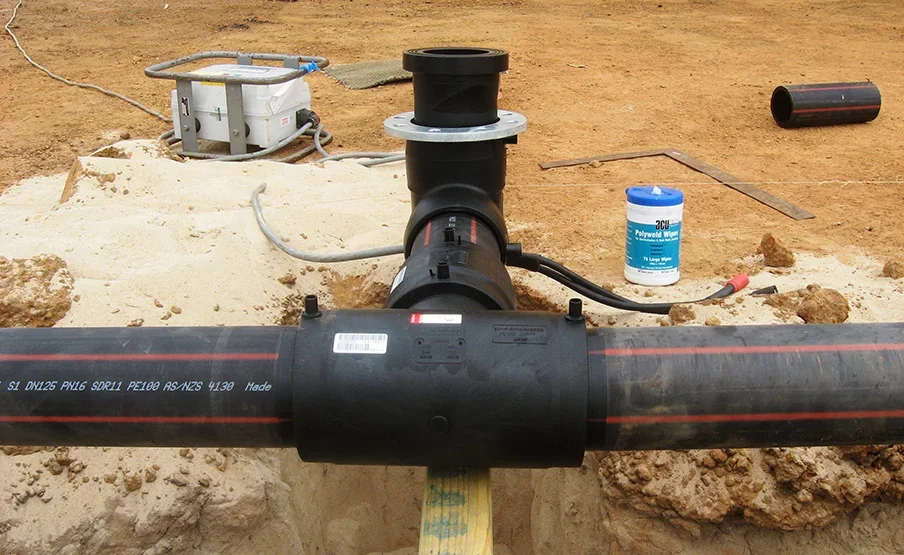
Electrofusion is more convenient in a trench, for repairs and for tapping into a live network. A coupler with an embedded heating wire joins the pipes without moving them, and the unit reads the mode from the fitting's barcode. It is chosen for small diameters, tight spaces and for joining pipes of different SDR if the fitting is rated for both. Each joint costs more by the price of the fitting. Suitable parts are in the electrofusion fittings section.
PE80 and PE100 pipes of the same SDR are butt welded with the same parameters, and the working pressure of the section is calculated for the weaker PE80 pipe. Pipes of different SDR cannot be butt welded: ends of different thickness heat unevenly, and the weld hides a lack of fusion.
The table only works if preparation is done right. The ends must be clean and dry, with no traces of grease. Edge misalignment is allowed up to 10% of the wall thickness. The gap after facing for pipes up to 355 mm must not exceed 0.5 mm. The heater plate is cleaned of stuck polyethylene before each joint. Its temperature is checked with a contact thermometer: the machine display can be off by several degrees.
The weather also changes the mode. SP 42-103-2003 allows welding at air temperatures from -15 to +45 °C, and outside this range work is done under shelter. Wind cools the pipe ends, so the free ends of the pipe are closed with caps. Typical mistakes are covered in detail in the article mistakes when welding HDPE pipes.
A finished weld is checked by its bead: it must be double and even around the whole circumference, and the groove between its halves must not drop below the pipe surface. Machines with data logging save the parameters of every joint, and on gas pipelines this data is attached to the as-built documentation.
Polimer Group Asia supplies butt fusion machines for polyethylene pipes up to 1600 mm with warranty and service, and the company's specialists train welders. PE100 water and gas pipes of all the diameters in the table are in the HDPE pipe section.

The plant has a capacity of 10,000 tons of polyethylene pipes per year. Our specialists carry out design and survey, design work on installation, installation and laying of pipelines for hot and cold water supply, heating, sewage, heating mains and drainage systems.
Address
Ziyolilar street, 4 a Tashkent, Uzbekistan