Mistakes when welding HDPE pipes
2023-07-06
Read more
Ziyolilar street, 4 a Tashkent, Uzbekistan
|
Working hours: Mon-Sun 9:00 - 18:00

Minimum slopes under SP 32.13330.2018, fall calculation, velocity and filling
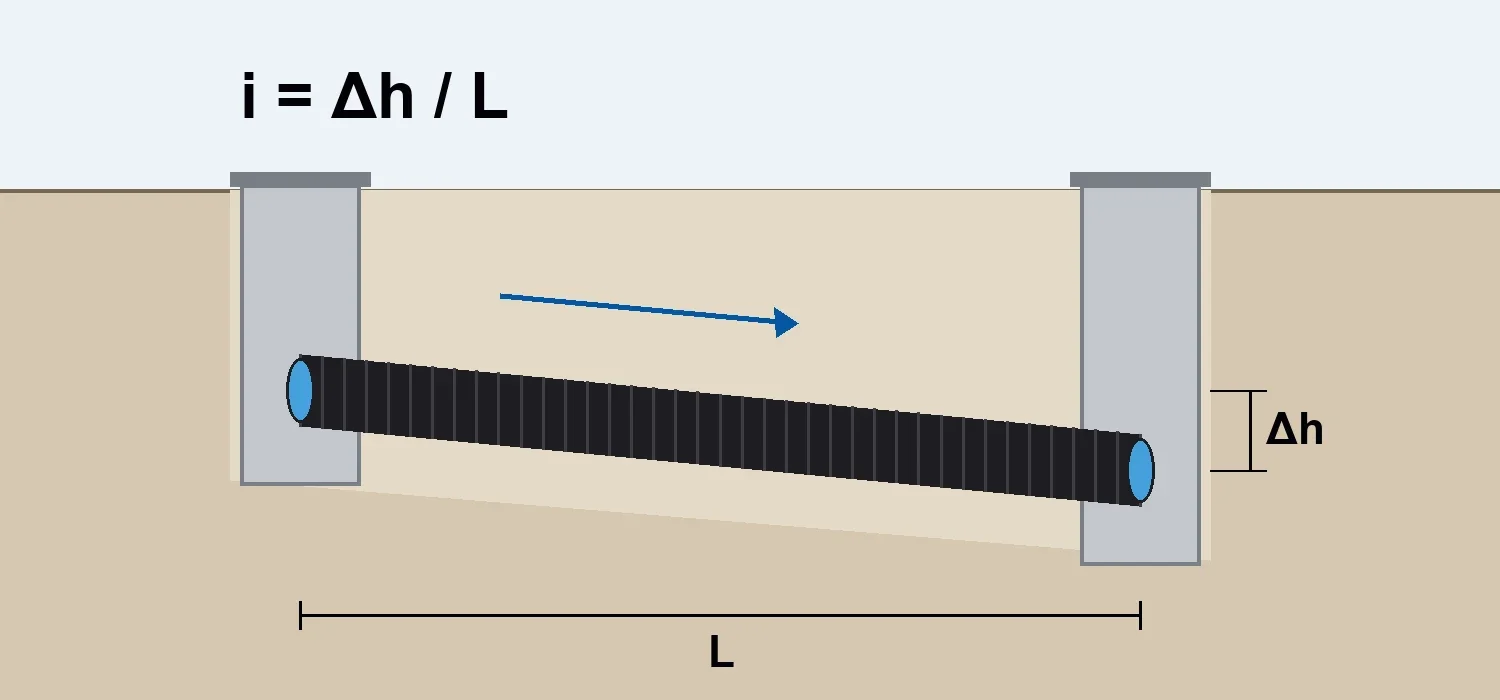
An external gravity sewer is laid with a fall towards the manhole or the treatment plant, so that the flow leaves on its own and leaves no sediment behind. For a district network of 150 mm pipes SP 32.13330.2018 requires a slope of at least 0.008, which is 8 mm per metre; for a street network of 200 mm pipes the minimum is 0.007. For larger diameters the slope is chosen by calculating the flow velocity.
The slope i is the difference in height divided by the length of the section: i = Δh / L. A slope of 0.02 means a fall of 2 cm for every metre of pipe. Over 25 m from a house to a manhole it gives a fall of 0.5 m. Designs write the slope as a decimal (0.008), in per mille (8 ‰) or as a percentage (0.8%); all three are the same value.
The fall is measured at the invert, the bottom of the inner pipe surface. Invert levels at the start and end of a section are set in the manholes, and between them the pipe is laid straight, without sags. Every sag collects sediment over time.
The wider the pipe, the smaller the slope it needs to reach self-cleansing velocity. The values for 150 and 200 mm networks below come from SP 32.13330.2018 "Sewerage. External networks and facilities", the value for 100-110 mm building drains comes from the internal sewerage code SP 30.13330. Designs in Uzbekistan check them against the current ShNK codes.
| Pipe diameter, mm | Where it is used | Minimum slope | Fall per 10 m |
|---|---|---|---|
| 100-110 | building drain to the first manhole | 0.02, not less than 0.012 | 20 cm |
| 150 | district and yard network | 0.008 | 8 cm |
| 200 | street network | 0.007 | 7 cm |
With justification, SP 32.13330 allows 0.007 for 150 mm pipes and 0.005 for 200 mm pipes on individual sections. The same code sets the smallest diameter of a street gravity sewer at 200 mm and of a district network at 150 mm.
For large diameters the standard sets velocity and filling rather than slope. At the design flow the pipe must be filled no more than a set share of its cross-section, and the water must not move slower than the self-cleansing velocity:
| Pipe diameter, mm | Minimum velocity, m/s | Maximum filling |
|---|---|---|
| 150-250 | 0.7 | 0.6 |
| 300-400 | 0.8 | 0.7 |
| 450-500 | 0.9 | 0.75 |
| 600-800 | 1.0 | 0.75 |
The maximum velocity for plastic and other non-metallic pipes is 4 m/s. For a first estimate engineers take a slope of about 1 / D, where D is the bore in millimetres: roughly 0.0033 for a 300 mm bore and 0.002 for a 500 mm bore. The final value is checked by a hydraulic calculation using the Lukinykh tables or the Chezy formula.
On a yard network a 40 m section at 0.008 gives a fall of 0.32 m. If the invert in the first manhole is 1.2 m deep, in the second it will be at 1.52 m plus the difference in ground level between the manholes.
Double-wall corrugated pipes are named by their outside diameter, while the standard and the hydraulic calculation use the bore. In a corrugated pipe the bore is about 13-15% smaller than the outside diameter: an OD 160 pipe is closer to 140 mm than to 150 mm in cross-section. That is why a yard network that needs a 150 mm pipe usually gets OD 200, and a street network gets OD 250. The inner layer of a double-wall pipe is smooth, so the flow moves along it without hold-ups.
A slope steeper than the standard is harmful too: above 4 m/s the water runs ahead and the solids stay on the walls. If the terrain gives more fall than needed, it is taken up by a drop manhole.
A common cause of blockages is a pipe settling in loose soil. The pipe is laid on a levelled sand bed 10-15 cm thick, and the sides are backfilled with sand compacted layer by layer; otherwise some sections end up with a reverse slope.
The depth is also set by the standard. Under SP 32.13330 the invert of pipes up to 500 mm may lie 0.3 m above the frost depth, but the top of the pipe must be at least 0.7 m below the ground surface. Ring stiffness is chosen by depth and load: SN4 suits yards and lawns, SN6 and higher suit greater depths and loaded sections.
For gravity networks the plant makes double-wall corrugated pipes SN4 and SN6; all types are in the Corrugated and drainage pipes section. If the sewage is pumped, you need a pressure pipe chosen by pressure, as described in the article "SDR and PN: how to choose a polyethylene pipe by pressure". Our managers will size the pipes for your project; phone numbers are on the Contacts page.
Usually 2 cm per metre (0.02), at least 1.2 cm per metre (0.012). Over 10 m of route a 0.02 slope gives a fall of 20 cm.
The standard for 150 mm pipes is 0.008, or 8 mm per metre. An OD 160 corrugated pipe has a bore of about 140 mm, so it is given at least 0.01 or replaced with an OD 200 pipe.
Yes, as long as the flow in a plastic pipe stays below 4 m/s. A large terrain drop is taken up by a drop manhole.
With a level or a laser against the invert levels in the manholes. On a short section a spirit level and a 2 m straightedge will do: for a 0.02 slope put a 4 cm block under the lower end and the bubble should sit in the middle.
Under SP 32.13330 the invert of pipes up to 500 mm may be 0.3 m above the frost depth, but the top of the pipe must be at least 0.7 m below the ground surface.
A gravity network uses double-wall corrugated SN4-SN6 pipes with a smooth inner layer. A pressure network after a pump uses PE100 pressure pipes with an SDR matched to the network pressure.

The plant has a capacity of 15,000 tons of polyethylene pipes per year. Our specialists carry out design and survey, design work on installation, installation and laying of pipelines for hot and cold water supply, heating, sewage, heating mains and drainage systems.
Address
Ziyolilar street, 4 a Tashkent, Uzbekistan